
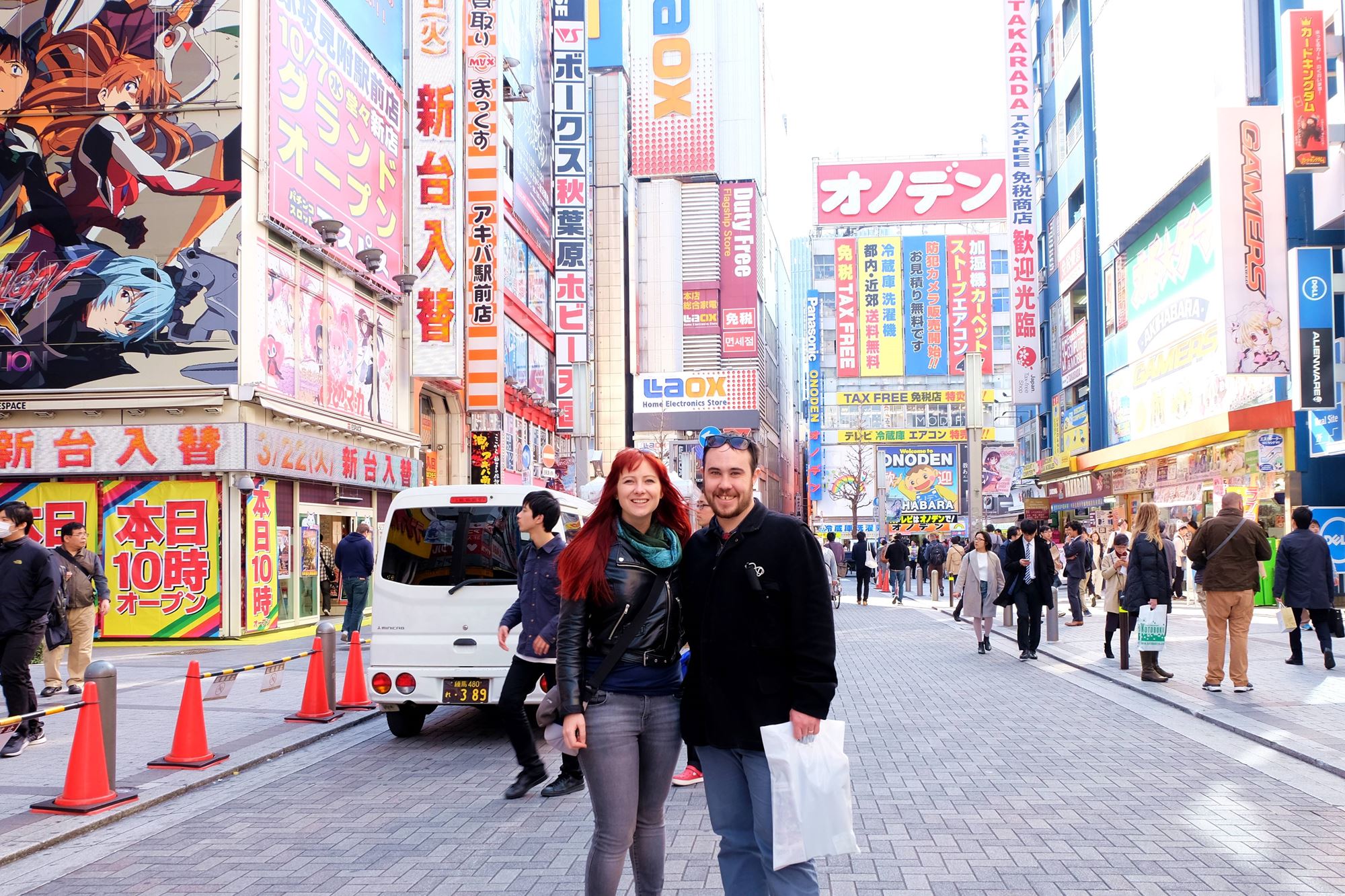
Two weeks to journey through Japan is not enough. But if you’re like us and you have limited time and/or funds, you can probably squeeze in most of what you want to experience into a fortnight.
We travelled to Japan in spring because it coincided nicely with a four day Easter weekend, the end of the ski season and (hopefully) the start of the cherry blossom season. It was also around the time of my 30th birthday and I couldn’t think of a better way to celebrate!
And, guess what? We timed our trip to Japan perfectly! Check out Dan’s awesome video (above) to see for yourself!
We were able to do and see plenty of things during our short holiday in Japan, but, in hindsight, there are a few things we would have done differently…
Our two week itinerary in Japan
Dan wanted to squeeze in some snowboarding. I wanted to explore the culture and the food. We both wanted to see the cherry blossoms. So, we researched it all, purchased flights in and out of Narita Airport near Tokyo, and finally decided on this:
Tokyo (4 nights) > Jigokudani Monkey Park (day trip on our way out of Tokyo) > Akakura Onsen (3 nights) > Kyoto (3 nights) > Hiroshima (day trip on our way to Miyajima Island) > Miyajima Island (2 nights) > Hakone Yamote (2 nights) > Tokyo (1 night)
Journey through Japan: what worked
Getting the 14 Day JR Pass (Japan Rail Pass)
The JR Pass was cost effective and easy to use after we activated it in Tokyo. It entitled us to unlimited use of the JR network between destinations and the JR network in cities like Kyoto and Tokyo. We were also entitled to unlimited use of the JR ferry to Miyajima Island.

Staying in a traditional Japanese ryokan in an onsen town
This is a cultural experience that I think everyone should have when they visit Japan. In Akakura Onsen we stayed in a lovely Japanese ryokan (guest house/ inn) featuring an onsen (hot spring). It was relaxing and awesome, and I highly recommend you do the same!
A day trip to Hiroshima
We visited Hiroshima as a day trip between destinations. It was a great idea because you don’t actually need much time in Hiroshima if you only want to see the Peace Park and museum. (There’s not much else to see in Hiroshima that you can’t see elsewhere in Japan).
The Hiroshima Peace Memorial Museum is a museum located in Hiroshima Peace Memorial Park, in central Hiroshima. It’s dedicated to documenting the World War II atomic bombing and takes about an hour to walk through. It’s a harrowing experience but well worth it to see the events and aftermath of the atomic bomb in an unbiased and straightforward manner.
Mobile internet
We wanted to stay online during out time in Japan, and not only to holiday spam our friends on Instagram and facebook. We also wanted quick and easy access to train timetables via HyperDia and easy access to Google Maps so that we could navigate our way through the big cities Thankfully, in the land that gave us many technological advances and pokemon, there are also plenty of telecommunication providers that rent portable Wi-Fi devices and mobile phones by the day.
Before we arrived in Japan, we ordered a pocket-sized Wi-Fi device online through PuPuRu. It was delivered to our hotel before we arrived, and came with a charger and a return envelope so that we could post it back to the company from the airport when we departed. It made it super easy to access internet simultaneously on our mobile phones, tablet and laptop throughout our trip.
Packing light
Over the years, we’ve learned to pack light: a small daypack for overnight or weekend trips, and carry-on luggage for longer trips. And, I’m glad our packing strategy Japan was no different!
Because we were on the move quite often, battling the crowded train stations would have been much more difficult with a large backpack or too much heavy luggage. We had Dan’s large snowboarding bag with us for the first part of our trip, and it was a bitch when we had to drag it up and down stairs through train stations in addition to our other luggage. Without it, we were able to glide more easily to and from destinations with our light carry-on bags.

Storing luggage on day trips
Every big train station has different sized coin lockers to store your luggage for around ¥500-700 per use. We used the coin lockers to store our bags in Nagano train station on our day trip to Jigokudani Monkey Park, and again in Hiroshima train station when we went to Hiroshima. They are conveniently located and easy to use – just make sure you get in earlier to nab one of the larger ones if you need it, and have plenty of ¥100 coins at your disposal.
Shipping luggage between destinations
There is a fantastic hotel-to-hotel delivery service in Japan that means you don’t have to drag your own luggage everywhere. Cost will vary depending on the shipping company the hotel chooses to use.
After Dan’s snowboarding adventures in the Japanese Alps (check out his video!), we asked the ryokan to store his large snowboard bag for a week and send it to our hotel in Tokyo so that it was there when we arrive. It cost around ¥1,600 (£10).
Journey though Japan: what would we change?
Getting the 14 Day JR Green Pass (Japan Rail Pass)
Because of the length of some of our journeys (Akakura Onsen to Kyoto was a local train and two Shinkansens over five hours), we decided to purchase the Green Car JR Pass instead of the standard JR Pass.
The chairs are much more luxurious, you get much more leg room, and … well that’s just it. Other than a little bit more space and luxury, the Green Car wasn’t much different to the reserved seating car. But there was also a difference of about £60 per ticket. For a small savings, I would be totally happy with the standard JR Pass.
Reserving train seats in advance
There are some train routes which can get very busy and crowded, even in the middle of the day. It’s better to reserve train seats at the train station a day or two before your intended journey.
When we tried to reserve seats from Kyoto to Hiroshima on the same day, we were told that there were no seats left to reserve (in the Green Car or standard car) on the 11am train and that we would have to wait for the 3pm train to Hiroshima. This would mean that we wouldn’t have enough time in Hiroshima to see all that we wanted to see.
We had to take a detour to Shin-Osaka station and lined up with hundreds of others to try and battle for a seat in the unreserved car to Hiroshima. Some of our group ended up standing with their backpacks for a few stops until they could get a seat for the 90 minute train journey.
On some train trips, we were completely on our own!

More time in Kyoto and Tokyo
We’re divided. Dan thinks that if we had to change anything it would be to have more time in Tokyo. If I could change anything, it would be more time in Kyoto. Both cities are so incredibly different but have so much to offer.
Kyoto is an historical hub full of shines, temples and old artefacts that really give you a sense of where the Japanese people have come from and what they have gone through. It’s easy to navigate by bus or on foot, and it’s a much smaller city than Tokyo, which means that there are many more tourists (domestic and international) crammed into a smaller area and the biggest tourist attractions. It’s also a great destination if you like antique shopping and history.
Tokyo is a cultural hub that will explode your senses. It’s a huge city, with millions of people, and hundreds of things to see and do. I loved it for the food, the culture, and the considerate people. Dan loved it because he just likes big cities – and Tokyo is as big as they come! There are also plenty of smaller cities and areas within Tokyo, each with its own distinct personality and atmosphere.
More day trips from Tokyo and Kyoto
Japan is a relatively small island nation and the train network is fast and simple to navigate. So, it’s easy to stay based in a larger city and take day trips to smaller towns or destinations. Or, if you decide to do a stopover between destinations, every train station has coin lockers to store your luggage for about ¥500-700 per use.
In Hiroshima, you can visit the Hiroshima Peace Park and museum, have a delicious Okinamiyaki lunch, and visit the Hiroshima Castle in about 4-6 hours.
On Miyajima Island, you can walk up and down Mt Misen (or take the cable car), see the floating Torii gate, run away from some deer, have lunch, and explore a few shrines in about 4-6 hours. And, the train + ferry from Hiroshima station takes about 45 minutes.
You can easily visit Hakone in a day from Tokyo. You can even get the Hakone Free Pass which will include all of your train, cable car and ferry (pirate ship) costs to and from Tokyo.

And, from Kyoto, you can visit Osaka and Nara for more historical sites and cultural hubs.
We stayed overnight in some lovely places, but we probably could have spent more time in Kyoto and Tokyo had we done day trips instead of overnight trips.
Read more recommendations and tips from our Journey through Japan
In March 2016, we went on an epic journey through Japan with thirteen of our friends. We experienced the amazing culture, ate some of the most incredible food and truly experience the best Japan has to offer. Here are all of my helpful tips to help you plan the perfect holiday in Japan:
Our two week itinerary (with tips and what we’d change)
25 photos that will inspire you to visit Japan
Culture Shock: reflections on my first day in Japan
Three days in Tokyo: a tantalising taste of Japan
The top ten things to do in Tokyo, Japan
Food in Japan: the best izakaya (Japanese pub) to drink and eat at in Tokyo
Food in Japan: where, what and how to eat in Japan
Journey through Japan: The Year of the (Japanese Snow) Monkey
How to onsen (enjoy hot springs) in Japan like a local
Journey through Japan: Snowboarding in the Japanese Alps (video)
Journey through Japan: Two days in Kyoto
Journey through Japan: A day in Hiroshima
Nature’s annual travelling show, cherry blossoms!
Follow @jacquitravels on Twitter and Instagram, and Never Ending Honeymoon on Facebook for live travel updates and photos.





Leave a Reply